
What Goes Into a Septic Tank Installation in El Dorado, KS
If you're building a new home in Butler County or replacing a failed system, septic tank installation is one of the most significant projects your property will go through. It's not just digging a hole and dropping in a tank — there's a process, and understanding it upfront saves you time, money, and headaches.
At Sunflower Plumbing, we've handled septic installations across El Dorado, Andover, Augusta, and the surrounding Butler County area. Here's a straightforward look at what the process actually involves.
Step 1: Site Evaluation and Soil Testing
Before anything gets permitted or purchased, the ground has to be tested. A perc test (percolation test) determines how well your soil absorbs water. This directly affects what type of system you can install and where it can go on your lot.
In Butler County, the Kansas Department of Health and Environment (KDHE) sets the standards, and Butler County Environmental Health administers the local permitting process. If your soil doesn't pass a standard perc test, you may need an alternative system — mound systems and aerobic treatment units are common solutions in this area.
Step 2: Permits and Site Plan Approval
You cannot legally install a septic system in Kansas without a permit. Once your soil evaluation is complete, a site plan gets submitted to Butler County Environmental Health showing the proposed tank location, drain field layout, setbacks from the well, property lines, and structures.
Setback requirements are strict. In Kansas, septic systems must maintain minimum distances from wells, streams, property lines, and buildings. Getting this right on paper before the first shovel hits the ground is critical.
Step 3: Excavation
With permits approved, excavation begins. This is where the size of your lot and the soil conditions really matter. Rocky or clay-heavy ground — common in parts of Butler County — can slow the process and require additional equipment.
The excavation covers two areas:
- The tank pit — sized for your tank, typically 1,000 to 1,500 gallons for a residential install
- The drain field trenches — the series of perforated pipes that distribute effluent into the soil
Our team at Sunflower Plumbing handles the excavation side of this work directly, so you're not coordinating between multiple contractors.
Step 4: Tank Installation and Plumbing Connection
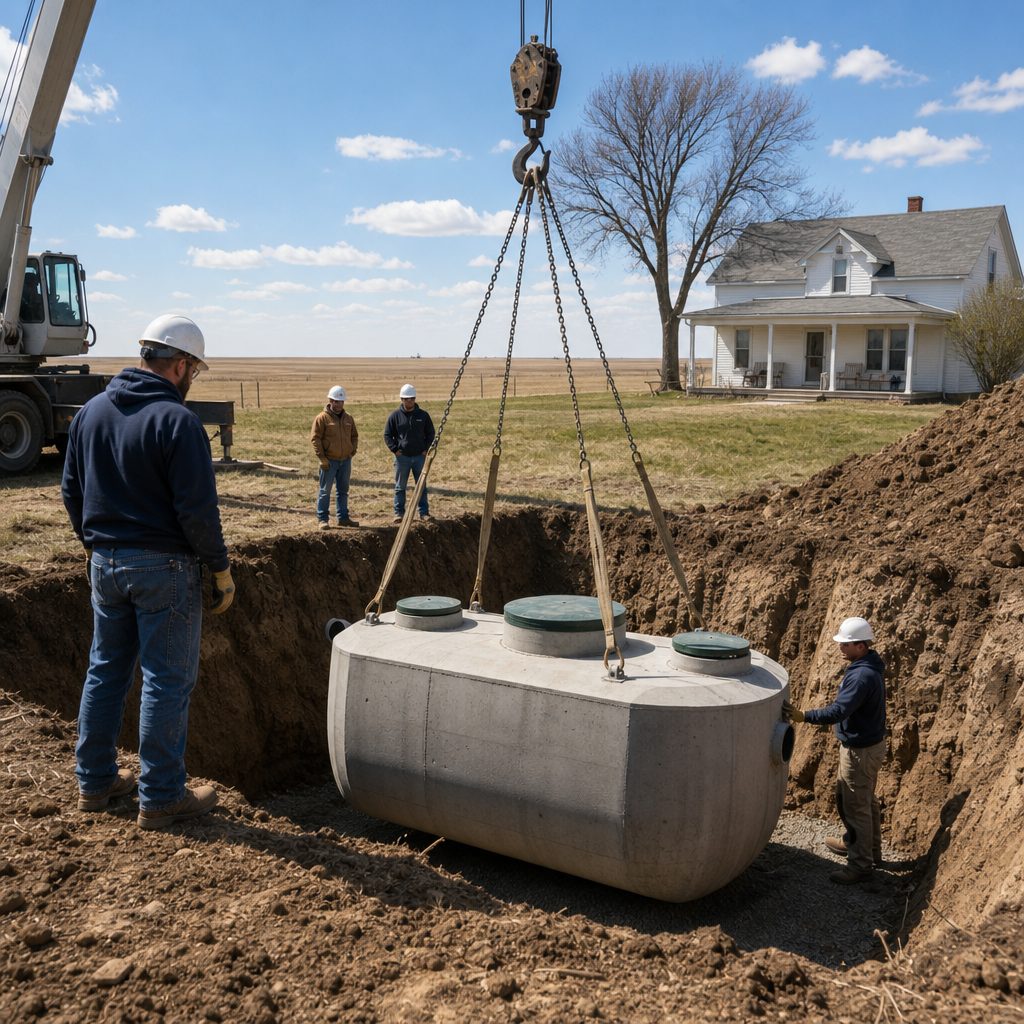
The tank — usually concrete or poly — gets set into the pit and leveled. Inlet and outlet baffles are inspected, risers are added for future access, and the tank gets connected to the home's main sewer line.
At this stage, all plumbing connections are made and inspected before anything gets covered. This is also when the distribution box (or D-box) is installed to split flow evenly across the drain field lines.
Step 5: Drain Field Installation
Perforated pipes are laid in gravel-filled trenches across the drain field area. The layout, depth, and spacing all follow the county-approved site plan. Fabric is placed over the gravel to prevent soil intrusion, and the trenches are backfilled.
The drain field is the long-term workhorse of your system. Done right, it'll function for decades. Done wrong, you're looking at drain field replacement — one of the more expensive septic repairs there is.
Step 6: Final Inspection and Backfill
Butler County Environmental Health will conduct a final inspection before the system can be covered and put into use. Once it passes, the tank and field areas are backfilled, graded, and seeded if needed.
You'll receive documentation on your system — keep it. Future buyers, insurers, and regulators will want it.
How Long Does Septic Tank Installation Take?
From first call to final inspection, most straightforward installations in the El Dorado area take two to four weeks — accounting for permit processing time, which Butler County typically turns around within a few business days to two weeks depending on volume.
Weather, soil conditions, and system complexity can affect the timeline.
What Does Septic Tank Installation Cost in El Dorado, KS?
Costs vary based on system type, tank size, drain field length, and site conditions. In the Butler County area, a standard residential installation typically runs in the $5,000–$15,000 range. Alternative systems — mound, aerobic — run higher.
If cost is a concern, ask us about financing options. We offer payment plans so a necessary system doesn't become a financial crisis.
Sunflower Plumbing Serves Butler County and Beyond
We're local. We know Butler County's soil, its permitting office, and its quirks. Whether you're installing a new system on a rural property outside El Dorado or replacing an aging tank in Augusta or Andover, Sunflower Plumbing handles the full job — from permit to final grade.
Ready to get started? Call us or request a quote online. We'll walk you through what your specific property needs before you spend a dime.