
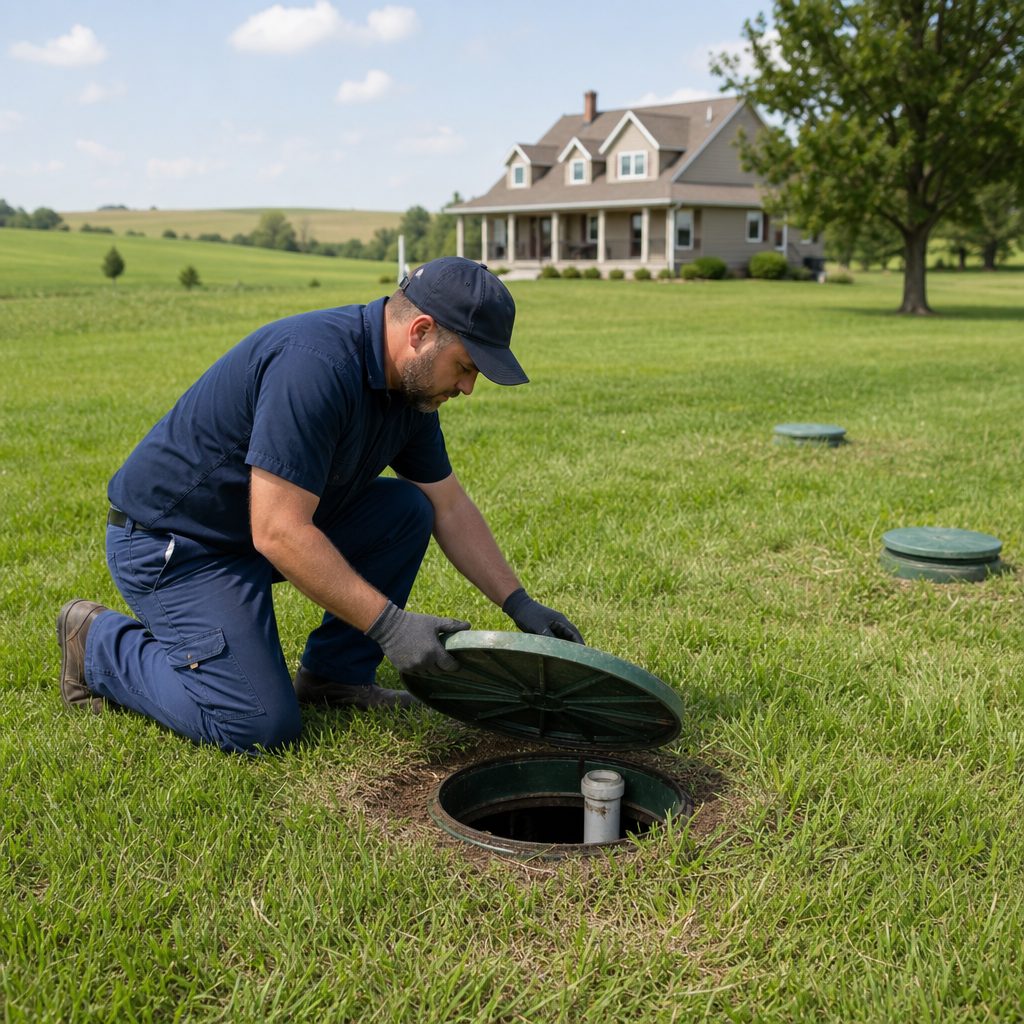
If you've noticed soggy patches in your yard that never seem to dry out, or caught a whiff of something unpleasant near your backyard, your drain field might be sending you a warning. For homeowners in El Dorado, Andover, Augusta, and across Butler County, a failing leach field isn't just an inconvenience — it's a health hazard and a financial problem that gets worse the longer it sits.
Understanding how drain fields fail — and what your repair options are — can save you from a much bigger headache down the road.
What Is a Drain Field and Why Does It Matter?
Your septic system has two main components: the tank and the drain field (also called a leach field). After solids settle in the tank, the liquid effluent flows out into a series of perforated pipes buried in gravel trenches underground. From there, the soil filters and absorbs the water naturally.
When the drain field works correctly, you never think about it. When it doesn't, you can't ignore it.
How Leach Fields Fail
Drain fields don't usually fail overnight. Most failures develop over months or years. Here are the most common causes:
1. Biomat Buildup
This is the number one cause of drain field failure. A biomat is a layer of organic material and bacteria that forms at the soil interface in the trenches. Over time — especially if a tank isn't pumped regularly — excess solids flow into the field and accelerate biomat growth. Eventually, the biomat becomes so thick it blocks absorption entirely.
2. Soil Saturation
Butler County has a mix of clay-heavy soils, particularly in low-lying areas around El Dorado and along creek drainages. Clay doesn't drain well to begin with, and if the soil becomes fully saturated (from heavy rainfall or system overload), the field loses its ability to process effluent.
3. Root Intrusion
Trees and shrubs planted too close to the drain field can send roots into the perforated pipes, cracking or clogging them over time.
4. System Overload
If a home adds occupants, increases water usage significantly, or has a leak that sends extra water into the system, the drain field can become overwhelmed faster than the soil can handle it.
5. Age
Most drain fields have a functional lifespan of 20–30 years. Older systems in rural Butler County — many installed in the 1980s and 90s — are reaching the end of that window.
Warning Signs You Shouldn't Ignore
- Soggy or spongy ground over the drain field area, even during dry weather
- Sewage odors in the yard or near the field
- Slow drains inside the house (toilets, tubs, sinks)
- Sewage backup into the home
- Unusually green or lush grass growing directly over the field lines — this often means effluent is surfacing
If you're seeing any of these, it's time to call a professional. Don't wait until sewage is surfacing — at that point, your repair options get more expensive fast. Check out our septic services page for a full look at what we handle.
Septic Drain Field Repair Options
The good news: not every failing drain field needs to be replaced. There's a range of repair options depending on how far the failure has progressed.
Aeration and Biological Treatment
For fields with biomat buildup that haven't completely failed, aeration can help break down the organic layer and restore some absorption capacity. This is often combined with bacterial treatments that accelerate decomposition in the trenches.
Pipe Jetting and Cleaning
If root intrusion or debris is clogging the distribution pipes, high-pressure jetting can clear the blockage and restore flow through the system.
Partial Field Replacement
In some cases, only a section of the field has failed. Replacing or rerouting damaged lateral lines — while leaving healthy sections intact — is significantly less expensive than a full replacement.
Full Drain Field Replacement
When a field is completely saturated or biologically dead, full replacement is the only option. This involves excavating the old field, addressing any underlying soil issues, and installing new perforated pipe and gravel in a new area of the yard. Our excavation team handles this kind of work regularly across Butler County.
Septic System Upgrade
Older systems may not meet current KDHE standards. In that case, a repair may need to include bringing the system up to code — particularly important if you're selling the property.
What to Expect During the Process
A proper diagnosis starts with a site inspection and often a camera inspection of the lines. From there, a repair plan is scoped based on the actual condition of the field — not a guess. At Sunflower Plumbing, we serve El Dorado and the surrounding Butler County communities, including Augusta, Andover, and Rose Hill. We've seen the full range of septic conditions that Kansas soil and weather can produce.
If you're not sure whether your system needs pumping, repair, or full replacement, our septic service page is a good starting point — or just give us a call and we'll walk you through it.
Don't Let It Wait
A drain field problem doesn't fix itself. The longer a failing system runs, the more damage accumulates — to the soil, to the pipes, and potentially to your water supply. Butler County homeowners on well water especially need to take drain field issues seriously, since a failing septic system can contaminate groundwater.
If you're dealing with soggy ground, slow drains, or septic smells on your property in El Dorado or anywhere in Butler County, reach out to Sunflower Plumbing. We'll assess the situation honestly and give you a clear picture of what it's going to take to fix it right.