
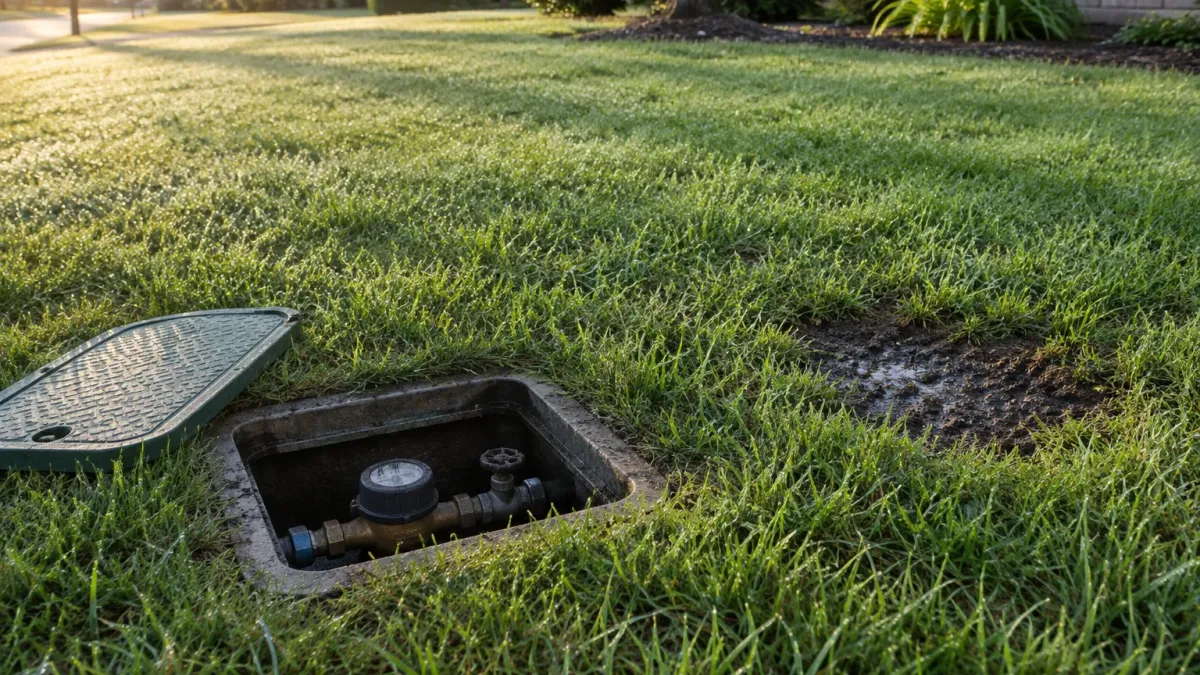
Leak detection starts with your water meter. If the meter keeps moving while every faucet and appliance in the house is off, water is escaping somewhere. From there, a plumber narrows down the location with pressure tests, listening equipment and sometimes a camera, so the repair can be limited to the spot that is actually failing instead of tearing open walls or floors to guess.
This post covers what you can check yourself, how professionals pinpoint a leak, why older homes in El Dorado deserve extra attention, and what changes the cost.
Start with the water meter: a check you can do in half an hour
Before you call anyone, the meter tells you whether you have a leak at all. It takes a few minutes of setup and a little waiting.
- Turn off every source of water use: faucets, dishwasher, washing machine, ice maker, irrigation system. Make sure no one flushes a toilet.
- Find your meter, usually in a ground-level box near the street or at the edge of your property. Lift the lid carefully.
- Look for the small leak indicator (often a little triangle or dial) that spins when any water moves through. If it is turning, water is flowing.
- If your meter has no indicator, write down the numbers on the register, wait at least 30 minutes with no water use, and read it again. A change means water is going somewhere.
Next, find the main shutoff valve where the water line enters the house and close it. Check the meter again. If it still moves with the house valve closed, the leak is on the buried line between the meter and your home. If it stops, the leak is somewhere inside the house plumbing.
That one split matters. A yard line problem points toward excavation. An inside problem points toward walls, floors, slabs or fixtures.
How plumbers actually pinpoint a hidden leak
Once a leak is confirmed, the job is to find the exact spot. Different situations call for different methods, and a good plumber often combines two or three.
Pressure testing. Sections of pipe are isolated and pressurized to see which section loses pressure. This narrows a whole house down to a single run of pipe.
Acoustic listening. Escaping water makes a faint hiss or vibration in the pipe. Sensitive microphones and ground sensors pick it up, and the loudest point is usually near the leak.
Thermal imaging. A leaking hot water line can leave a warm patch in a floor or wall. A thermal camera shows temperature differences that your eyes cannot see.
Moisture meters. These read how wet drywall, wood or concrete is, which helps trace damp areas back toward their source.
Camera inspection. For drain and sewer lines, a small camera on a flexible cable shows cracks, root intrusion, bellies and broken joints from the inside.
No single tool finds every leak. Access also changes the picture. A leak behind a tub with no access panel is harder to confirm than one under an open crawl space. When you talk to a plumber, ask which methods they plan to use and why.
If you have already noticed stains, musty smells or an odd water bill, our related guide on common signs of a hidden water leak walks through what to look for. If you would rather have someone confirm it, Sunflower Plumbing & Excavation can come out and track it down.
Why older El Dorado homes and the ground around them are worth a closer look
The median home in El Dorado was built in 1959, according to the U.S. Census Bureau's 2024 American Community Survey estimates. A house that age has often seen decades of wear on its plumbing. Homes from that period commonly have galvanized steel supply lines or cast iron drains somewhere, unless they have been updated. Those materials corrode from the inside, and pinhole leaks or slow weeps are a common way they fail.
Even if the interior pipes were replaced, the line running from the street to the house may be the original. Buried pipe fails quietly. Water soaks into the soil instead of showing up on a ceiling, so the first clue is often a higher bill or a soft, green patch in the yard.
El Dorado sits along the Walnut River in the middle of Butler County, and soil conditions around town vary. Wet ground can hide a leak because you cannot tell a leak from a rainy week. That is one reason the meter test is so useful: it measures what is going through the line no matter what the weather is doing.
This is also where having a plumber and an excavation crew under one roof helps. Sunflower Plumbing & Excavation handles leak detection, sewer line replacement and repair, and sewer and water line excavation. If a leak turns out to be under the yard, the same business can find it and dig to it.
What drives the cost of finding and fixing a leak
People searching for leak detection almost always want a price. Without seeing the house, nobody honest can give you a real number, but these are the factors that move it:
- Where the leak is. Exposed pipe in a basement or crawl space is quicker to check than a line under a slab or a driveway.
- How many methods it takes. A leak that shows up on a meter test and a pressure test is faster to isolate than one that needs extra equipment and several rounds of checking.
- Access. Tight spaces, finished walls and tile floors add time and may require opening a small section to confirm.
- Pipe material and condition. If the pipe is badly corroded, a plumber may recommend replacing a section instead of patching one spot.
- Detection versus repair. Finding the leak and fixing it are separate jobs. The repair might be a simple fitting or a trench to replace buried pipe.
- Excavation. A leak under the yard adds digging, backfill and grading to the work.
Sunflower Plumbing & Excavation lists transparent pricing as part of how it works. Ask for the price before work starts and ask what is included, so you know whether the figure covers just locating the leak or the repair too.
Frequently Asked Questions
How can I find where my water is leaking from?
Start with the meter test to learn whether the leak is inside the house or on the buried line. Then look for damp spots, stains, warped flooring or unusually green patches in the yard. To pinpoint the exact spot inside walls or underground, you generally need pressure testing and listening equipment that a plumber uses.
How much does it cost to trace a water leak?
It depends on where the leak is, how hard it is to reach, and how many methods it takes to confirm it. Repair is usually priced separately from finding the leak. Sunflower Plumbing & Excavation advertises transparent pricing, so call (316) 333-6326 and ask what the work will include before it starts.
Why is my water meter spinning even though there is no leak?
Something is probably using water that you have not thought of. Common culprits are an ice maker refill, a water softener regenerating, a sprinkler timer, a toilet that refills on its own, or a hose bib left slightly open. Run through every appliance, and if the meter still moves with everything off, treat it as a leak.
How is leak detection done?
A plumber confirms the leak with a meter check, then isolates the section with pressure testing. Acoustic microphones, thermal cameras and moisture meters help locate the exact point. For drain and sewer lines, a camera on a flexible cable shows damage from the inside. Most jobs use more than one method.
Can a leak be fixed without tearing out walls or floors?
Often the repair can be limited to a small opening because the leak has been pinpointed first. That is the main value of detection. Sometimes the pipe is too corroded or hard to reach, and a larger section needs replacing. A plumber should explain which situation you are in before cutting anything open.
Is a small leak worth fixing right away?
Yes. A slow leak keeps adding moisture to wood, drywall and soil, which can lead to mold, rot and a larger repair later. It also raises your water bill month after month. Small leaks are typically the cheapest to fix, and waiting rarely makes them smaller.
Call for leak detection in El Dorado and Butler County
If your meter is moving when nothing is running, or you suspect water is going somewhere it should not, get it checked before it becomes a bigger repair. Sunflower Plumbing & Excavation is a locally owned, licensed and insured business based in El Dorado, with 24/7 emergency service and regular hours Monday to Friday, 8am to 5pm.
See the leak detection service in El Dorado or call (316) 333-6326. The company also serves nearby towns, including Andover and Augusta.