
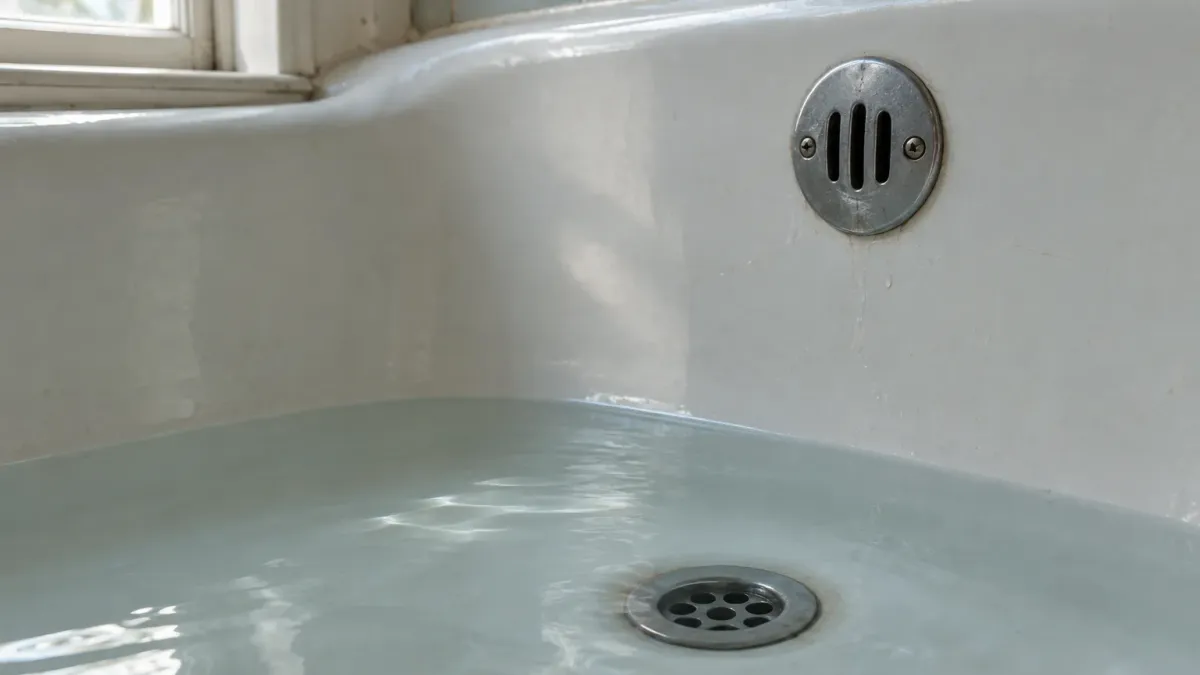
The median home in El Dorado was built in 1959, so plenty of local tubs have a bathtub drain and overflow that are decades old and hidden behind a wall. The two parts are openings that feed one pipe under the tub. The drain at the bottom empties the water, and the slotted plate on the wall below the faucet is the overflow. It catches water if the level climbs too high and lets air in so the tub empties smoothly. When one acts up, the cause is usually hair and soap at the stopper, a worn seal, or a tired gasket behind the overflow plate.
How the bathtub drain and overflow connect under the tub
Behind the overflow plate, a short pipe runs down the side of the tub. It meets the pipe from the drain at a fitting called a tee. From there the water travels through the trap and on to the main drain line. The trap is the curved section that holds a little water to keep sewer gas out of the room.
Because both openings share the same path, a problem past the tee affects both. A clog in the trap slows the drain and can push water or gurgling sounds up through the overflow. A leak at either connection tends to show up in the same place, which is the ceiling or wall below the tub.
The overflow does two jobs. It gives water somewhere to go if you walk away from a filling tub, as long as the faucet is not running faster than the overflow can carry. It also lets air in behind the draining water, and without that air a tub tends to gulp and drain slowly.
Plumbing codes generally expect a tub to have an overflow, so it is not a part you can leave off. If you are remodeling, ask your plumber what local code requires.
Bathtub drain stopper types and how to open and close each
Stoppers look alike but work differently, and the wrong motion can break the linkage. Here are the common types:
- Toe-touch: Press the cap with your foot to close it, and press again to release it.
- Lift-and-turn: Turn the knob to lock the stopper down or up. The direction depends on the model, so test it with a little water.
- Push-pull: Push the cap down to close it and pull it up to open it.
- Trip lever: A lever on the overflow plate moves a plunger or rocker inside the overflow pipe. Which position seals the drain varies, so fill the tub a few inches and see.
- Flip-it or plain rubber plug: Flip the lever or seat the plug by hand.
If a stopper will not close or will not stay open, the fix is often a loose cap, a worn rubber seal, or a linkage that has slipped out of adjustment. Those are simple, inexpensive parts.
If your tub is slow, leaking, or acting up and you would rather have someone look at it, Sunflower Plumbing & Excavation handles drain cleaning in El Dorado and the surrounding area.
Bathtub drain and overflow problems and what each one points to
A handful of symptoms account for most tub drain trouble.
- Slow drain: Hair and soap scum collect on the stopper, the strainer, and the first stretch of pipe. Pull the stopper and clean it first. Some habits that keep hair and soap from building up stop this from coming back.
- Tub will not hold water: The stopper seal is worn, the linkage needs adjusting, or the drain flange is not sealing against the tub.
- Stain or drip below the tub only when it is full: Suspect the overflow gasket. Water only reaches that connection when the level rises above the overflow opening.
- Stain or drip while the tub is draining: Suspect the drain shoe or flange, the parts directly under the drain opening.
- Water or gurgling in the overflow when another fixture runs: This points to a clog deeper in the line, and clogs like that are covered in this El Dorado drain clog repair post.
- Musty smell from the tub: Soap and hair film can build up inside the overflow opening and pipe, where a stopper cleaning will not reach.
You can sort out the leak question yourself. Fill the tub only to just below the overflow and watch the area underneath. Then raise the level above the overflow opening and check again. A leak that appears only in the second step points to the overflow connection. A leak while the tub drains points to the drain connection.
Why the tub drain and overflow in older El Dorado homes need a closer look
El Dorado's median home was built in 1959, and about 60% of homes are owner-occupied, according to the U.S. Census Bureau's 2024 American Community Survey 5-year estimates. Put those together and the picture is clear. Many tubs here have original or partly updated drain hardware, and the homeowner is the one paying for the repair.
Older metal drain pipe and fittings can corrode or collect scale over the decades. Many older tubs also have no access panel, so the connections sit behind a wall or under a floor. A job that looks like a simple stopper swap can turn into a hunt for the source of a slow leak.
That is also how small overflow leaks go unnoticed for months. The drip happens only when the tub is filled high, so you may see nothing until a ceiling stain or soft spot appears. If you suspect a hidden leak, leak detection is part of what Sunflower Plumbing & Excavation offers, along with drain cleaning and kitchen and bathroom plumbing.
Fixing a tub drain yourself or calling a plumber
Some work is safe for a careful homeowner. Cleaning the stopper and strainer, replacing a worn stopper cap, and tightening a loose overflow plate are all reasonable. A drain wrench or a pair of pliers and some patience cover most of it.
Hand it off when any of these are true:
- Water is showing up below the tub, on a ceiling, or in a wall.
- The overflow bubbles or gurgles when you run other fixtures.
- The drain shoe or flange needs replacing, especially with no access panel.
- The pipe behind the tub looks corroded or crumbly.
- Cleaning the stopper did not help the slow drain.
Be careful with store-bought chemical drain cleaners in a tub. They can sit in the overflow area and be rough on older fittings, and they make the next repair unpleasant for whoever has to open the pipe.
If you are weighing the cost of a repair, the price depends on what part failed, whether the plumber can reach it from above or below, the tub material, and whether a wall or ceiling must be opened. Ask any contractor for the price and what it covers before work starts. Sunflower Plumbing & Excavation is licensed and insured and keeps its pricing transparent.
Frequently Asked Questions
Does a bathtub need an overflow drain?
Yes, in almost every case. Plumbing codes generally expect a tub to have an overflow, and it also helps the tub drain smoothly by letting air in. It protects against spills when a filling tub is left unattended. If you are replacing or remodeling a tub, confirm local code requirements with your plumber.
How much does it cost to replace a bathtub drain?
It depends on the part that failed, how easy it is to reach, the tub material, and whether a wall or ceiling needs opening. A simple stopper swap costs far less than replacing a drain shoe behind a closed wall. Ask the plumber for the price and what it includes before work begins.
How to open and close a tub drain?
It depends on your stopper type. A toe-touch closes with a press of the foot and opens with another press. A lift-and-turn knob twists to lock it up or down. A trip lever on the overflow plate works a plunger inside the pipe. If you are unsure, test with a few inches of water.
Is it easy to replace a bath drain?
Replacing a visible stopper or strainer is usually easy with basic tools. Replacing the drain shoe or flange is harder, especially with no access panel under the tub. A poor seal there can cause leaks that damage the ceiling below. Hidden or corroded connections are a good reason to call a plumber.
Why is water coming up through my tub overflow?
Water rising in the overflow usually means a clog past the point where the overflow pipe joins the drain, often in the trap or farther down the line. Running a sink or washing machine can push water back up. Cleaning the stopper will not fix it, because the clog itself has to be cleared.
Why does my tub still drain slowly after I cleaned the stopper?
The clog is probably farther down, in the trap or the pipe past the tee. Hair and soap can also coat the overflow pipe and trap enough to slow the flow without fully blocking it. If cleaning the stopper did not help, have a plumber clear the line.
Call Sunflower Plumbing & Excavation about a tub drain or overflow problem
If your tub drains slowly, leaks below, or will not hold water, Sunflower Plumbing & Excavation can help with drain cleaning and the repairs that follow. We are locally owned in Butler County. We also serve nearby towns, including Augusta and Andover.
Call (316) 333-6326. Office hours are Monday through Friday, 8am to 5pm, and 24/7 emergency service is available if water is coming through a ceiling or a wall.